
(Additional content at flickr Photostream and YouTube Channel)
If you have botany questions or comments please email BobK . Thanks!
Cryptogams on Coarse Woody Debris
(a fancy name for a log)
October 30, 2010, Delaware County, Ohio.
The word "log" is too prosaic I guess, even though these are natural logs that use the base e, not stupid old common logs that use base 10. The forest ecologists call this substrate coarse woody debris, and abbreviate it "CWD."
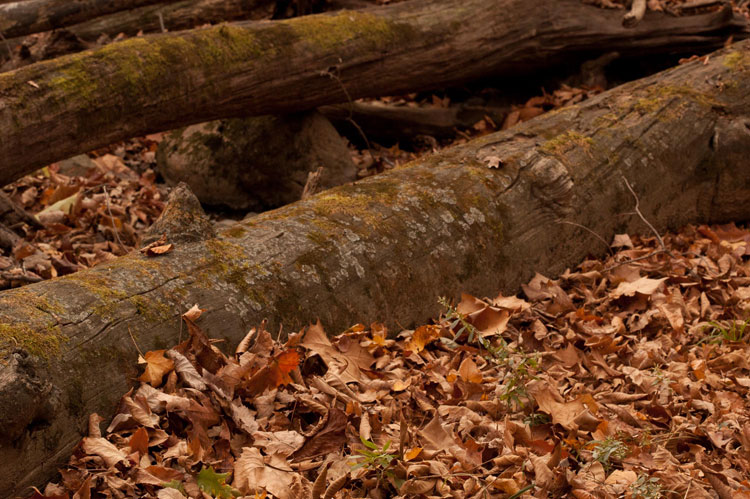
Coarse woody debris is a fancy name for logs, and a great substrate for cryptogams.
October 30, 2010. Delaware County, Ohio.
Southern Running-pine Releases Spores.Coarse woody debris is a fancy name for logs, and a great substrate for cryptogams.
October 30, 2010. Delaware County, Ohio.
One of the cryptogams that would not find it easy --or desirable --to fall off a log is also one of the few lichens to thrive in the shady forest environment. This is powder-tipped shadow lichen, Phaeophyscia adiastola. The lichen genus Phaeophyscia is comprised of narrow-lobed foliose species that sometimes displays a brownish cast instead of the light gray seen on the closely related "rosette lichens" in the genus Physcia. (The name means "brown Physcia.") Shadow lichens also have a much darker undersurface than do the rosette lichens. (This photo doesn't show the undersurface and, since it's a digital photo and not a print, you can't just turn it over to see what the lichen looks like beneath.)
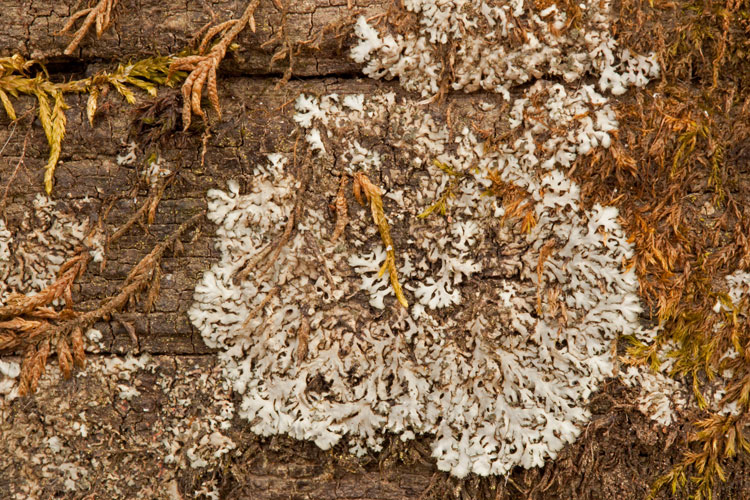
Powder-tipped shadow lichen is quite shade tolerant. October 30, 2011. Delaware County, Ohio.
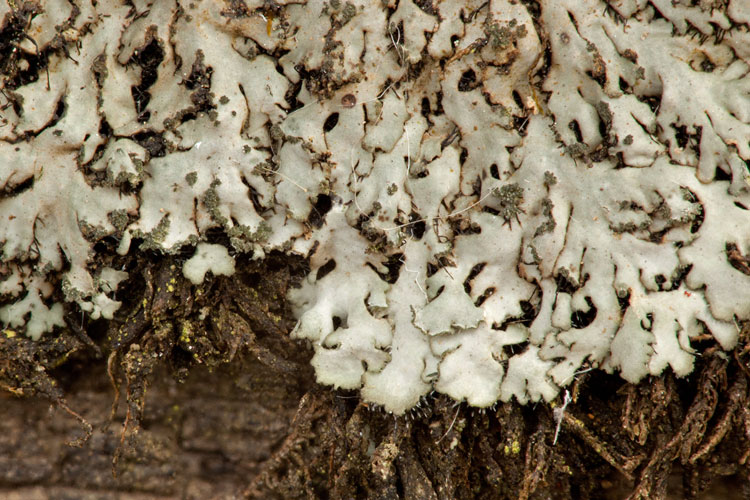
Powder-tipped shadow lichen is distinguished by its narrow lobes and granular marginal soredia.
Powder-tipped shadow lichen is quite shade tolerant. October 30, 2011. Delaware County, Ohio.
Here's a close-up of the thallus margin of the shadow lichen, showing the powder-tips, which are actually coarsely granular soredia. Soredia are a means of asexual reproduction consisting of minute, spherical bodies made up of a few alga cells in a tangle of fungal threads, capable of developing into a new lichen. Attachement strands called "rhizines" are also visible, extending put just a bit from the undersurface of the lichen, where they are abundantly produced.
Powder-tipped shadow lichen is distinguished by its narrow lobes and granular marginal soredia.
Powder-tipped shadow lichen is common and widespread in Ohio, and is said by Ray Showman and Don Flenniken in their terrific book "The Macrolichens of Ohio" (2004, Ohio Biological Survey) to occur "on mossy rocks and tree bases." Here's a photo of the same species at this location, but a different substrate --a mossy rock --taken a couple of weeks earlier. This was just after a rain, and shows well one of the nifty things about many lichens (and mosses too) --their striking difference in appearance dry versus wet.
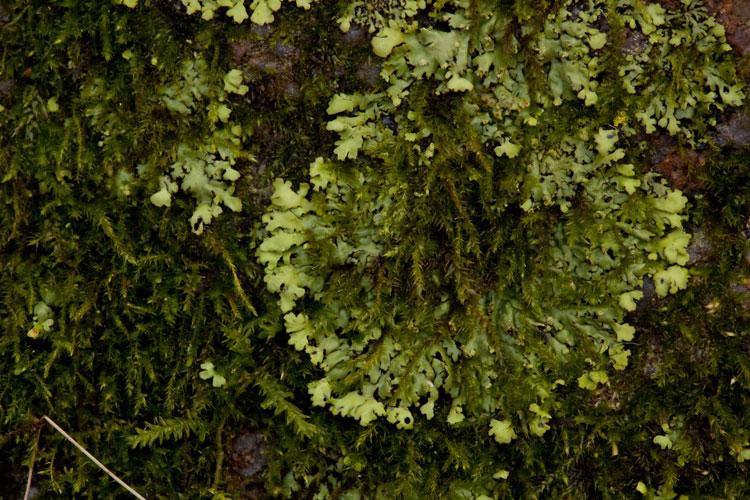
Powder-tipped shadow lichen on a wet day, on a rock.
October 21, 1020. Delaware County, Ohio.
Powder-tipped shadow lichen on a wet day, on a rock.
October 21, 1020. Delaware County, Ohio.
The other cryptogam logging in some CWD time is Entodon cladorrhizans (Entodontaceae). This is a common carpet moss moss found on rotten wood, bark at the base of trees, and on logs and rocks. Entodon stands out by virtue of its shiny, erect-spreading, somewhat flattened leaves.
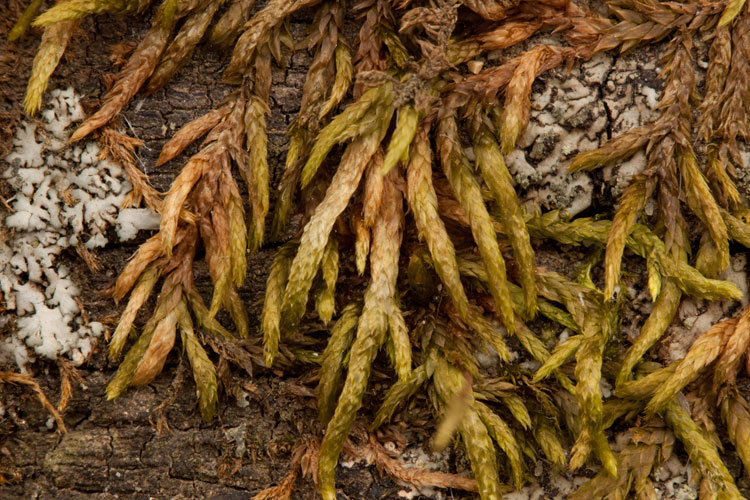
Entodon cladorrhizans is an especially shiny carpet moss. October 30, 2010. Delaware County. Ohio.
Entodon cladorrhizans is an especially shiny carpet moss. October 30, 2010. Delaware County. Ohio.
Well, while that lazy tuft of Entodon is just sitting there like a bump on a log, a nearby patch of the Entodon moss is much more actively engaged in reproduction. This specimen displays not only the persistent leafy egg and sperm producing "gametophyte" stage of the life cycle (which, uniquely, is the dominant stage in mosses, as well as in the other "bryophyte" plants, hornworts and liverworts). Here we see their progeny, the relatively simple and small spore-producing "sporophytes." Each sporophyte consists of a long slender supporting stalk (the "seta") tipped by the all-important spore case, the "sporangium." Each sporophyte is actually a separate plant, the offspring of the gametophyte to which it it is attached (its mother, actually).
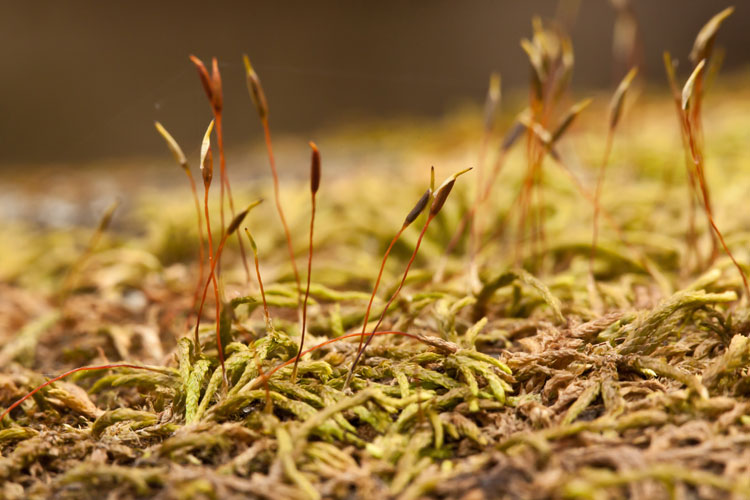
Entodon moss displays both stages of the plant life cycle.
October 30, 2010. Delaware County, Ohio.
Entodon moss displays both stages of the plant life cycle.
October 30, 2010. Delaware County, Ohio.
October 24, 2010.
Deep Woods Preserve. Hocking County, Ohio.
Clubmosses, i.e., members of the plant family Lycopodiaceae, are a diverse and ancient group of seedless plants that have tiny scale-like leaves. Ohio is home to 13 such "lycopods," all of which were at one time classified within one too-large genus called Lycopodium. The clubmosses are now more sensibly parcelled into 4 easily distinguished genera: Huperzia for the ones lacking a horizontal stem (stolon), and bearing sporangia in the axils of quite normal-looking foliage leaves (H. lucidula, shining clubmoss, is an example); Lycopodium for the stoloniferous ones that have cone-like aggregates of sporangia (strobili) that are elevated on leafless stalks, and the ultimate vegetative branches of which are rounded (L. obscurum, ground-pine, is an example); Diphasiastrum for the stoloniferous and naked-stalked ones with flattened branches (the subject of today's plant-quest, D. digitatum, southern running-pine, is an example), and; Lycopodiella, which bears leafy club-stalks (L. inundata, southern bog-clubmoss, is an example).
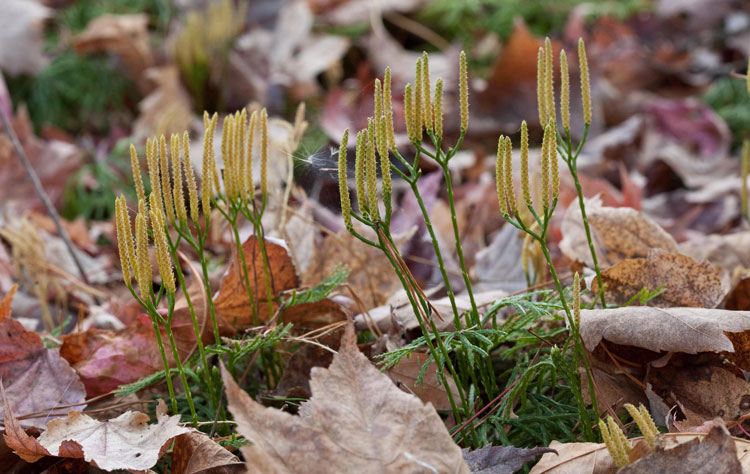
Diphasiastrum digitatum spreads by horizontal stems, and produces upright tree-like stems.
October 24, 2010. Hocking County, Ohio.
There's No Pidia Like Porpidia!Diphasiastrum digitatum spreads by horizontal stems, and produces upright tree-like stems.
October 24, 2010. Hocking County, Ohio.
The upright stems are evergreen and dichotomously branched. They resemble little pine trees, hence the name "running pine."
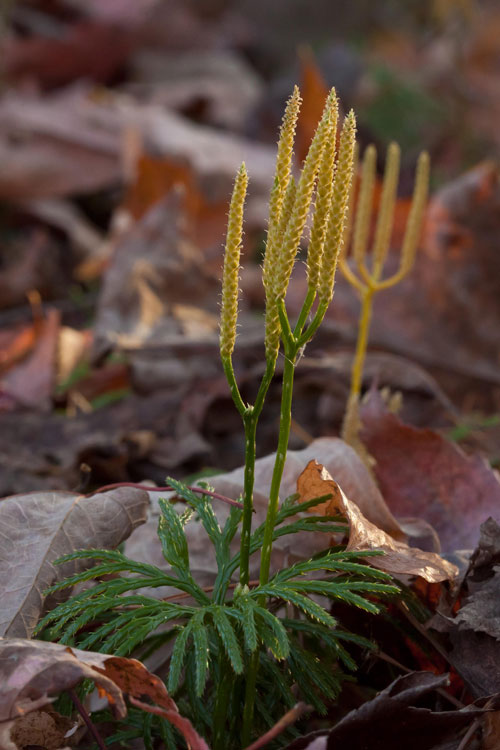
Diphasiastrum digitatum produces stobili on naked peduncles.
Diphasiastrum digitatum produces stobili on naked peduncles.
The genus Diphasiastrum is distinguished by the flatness of its branches, and leaves that are scale-like, fused togehter with only their tips projecting away from the branch. Early botantical manuals call this common Ohio plant Lycopodium complanatum, and there is indeed still a Diphasiastrum complanatum that was once considered part of a more encompassing Lycopodium complantum), but that is now regarded as a separate boreal species, "northern running-pine," which doesn't occur in Ohio.
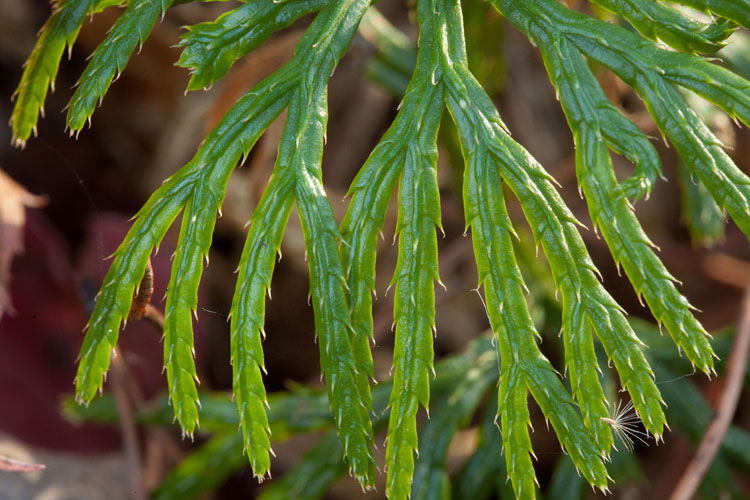
Diphasistrum branches are flat, with appressed leaves.
Diphasistrum branches are flat, with appressed leaves.
This last half of October is an ideal time to gather clubmoss spores, because now the sporangia are ripe and splitting open to release them.
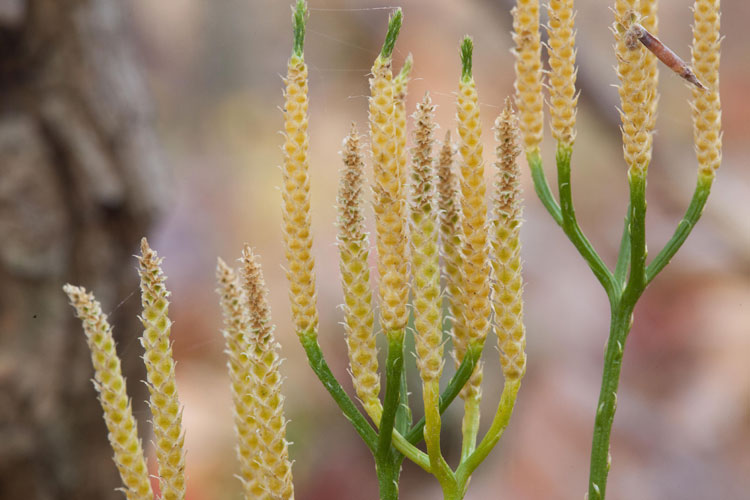
Clubmoss sporangia are produced at the bases of pale reduced leaves arranged in a club-shaped cone.
October 24, 2010. Hocking County, Ohio.
Clubmoss sporangia are produced at the bases of pale reduced leaves arranged in a club-shaped cone.
October 24, 2010. Hocking County, Ohio.
Why on earth would someone gather clubmoss spores? Because they're flammable, in a very fun and educational way. Tossed onto a candle flame, they ignite with a bright flash. Woot-woot! Introductory biology teachers at regional campuses of great midwestern Universities have been known to do this in class, to illustrate the use of clubmoss spores in early flash photography. The video below shows that spores are indeed produced within these strobili, and also includes a short fair use (please do no sue me, MGM Studios) excerpt from the 1960 Spencer Tracy movie about the Scopes Monkey Trial, "Inherit the Wind," depicting courtroom photographers using flash powder.
While clubmoss releases spores, a stick insect inherits the wind.
Nearby, a northern walkingstick, Diapheromera femorata (Order Phasmatidae) tries to look very inconspicuous, perhaps trying out for a role as a "northern walkingstrobilus." Walkingsticks are herbivores on forest trees. They mate in the fall, and the female drops fairly large eggs said to have a striking resemblance to seeds, randomly about on the forest floor.
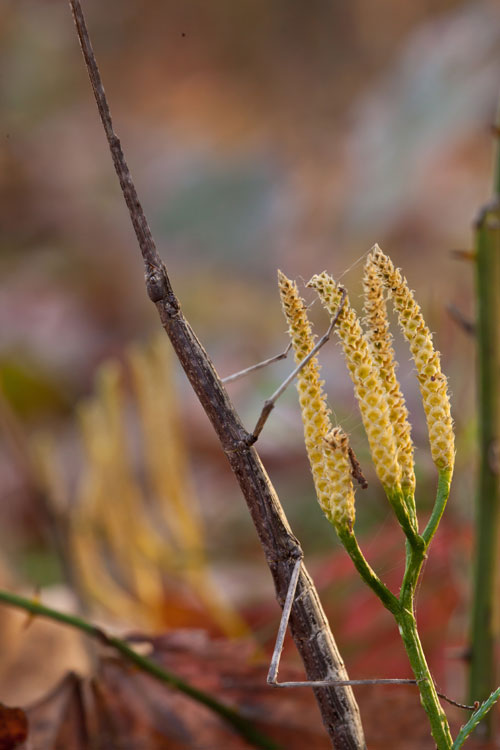
The stick insect, Diapheromera femorata, mates and lays eggs in autumn.
October 24, 2010. Hocking County, Ohio.
While clubmoss releases spores, a stick insect inherits the wind.
Nearby, a northern walkingstick, Diapheromera femorata (Order Phasmatidae) tries to look very inconspicuous, perhaps trying out for a role as a "northern walkingstrobilus." Walkingsticks are herbivores on forest trees. They mate in the fall, and the female drops fairly large eggs said to have a striking resemblance to seeds, randomly about on the forest floor.
The stick insect, Diapheromera femorata, mates and lays eggs in autumn.
October 24, 2010. Hocking County, Ohio.
(Dude, that makes no sense whatsoever!)
There's No Cranum like Dicranum, either.
October 17, 2010. Delaware County, Ohio.
The glaciers that once occupied this area were evidently quite the litterbugs, leaving behind a coarse heterogenous mixture of rock particles of various sizes called till, including some large boulders that are called erratics because they were carried quite some distance and often have a different composition than the other rocks in the area. In this woodland in Delaware County, located within the Till Plains region of the state which is characterized by an alkaline, shale/limestone-based soil chemistry, we see grantic acidic silicious boulders wantonly tossed aside by those inconsiderate ice-heads.
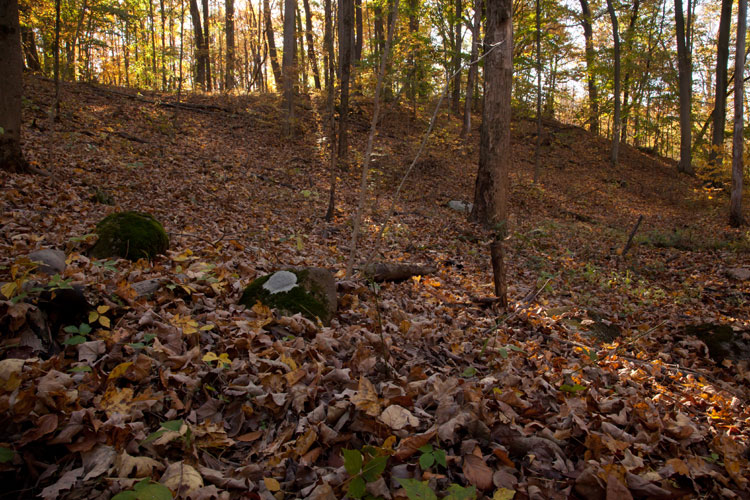
"Kraus Woods" Delaware County, Ohio. October 17, 2010.
Chinese Mantid Oviposits on Asian Honeysuckle"Kraus Woods" Delaware County, Ohio. October 17, 2010.
One of the intriguing things about wee little cryptogams that grow on rocks is that they are are often somewhat particular as to the type of rocks upon which they do their growing. As a case in point, note the large rock near the center of the photo above ...the one with the white circular patch.
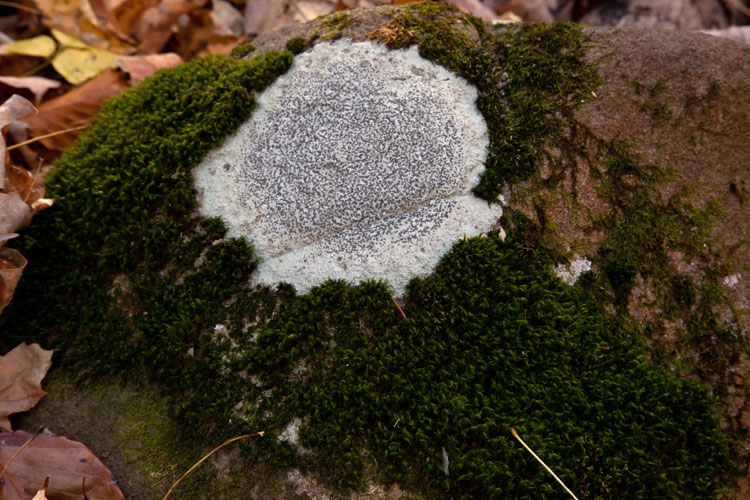
Saxicolous cryptogams share shady granitic boulder.
October 17, 2010. Delaware County, Ohio.
Saxicolous cryptogams share shady granitic boulder.
October 17, 2010. Delaware County, Ohio.
Two fairly substrate-specific cryptogams grow here --a moss and a lichen. The lichen is a great joy to behold because it's one of the few lichens having a crustose growth form that can identified without devoting the rest of your life to lichenology. It's "smoky-eyed boulder lichen," Porpidia albocaerulescens. Irwin Brodo, in his magnificant and very reasonably priced tome, Lichens of North America (Yale University Press), co-authored with photographers Silvia Duran Sharnoff and Stephen Sharnoff, tells us that this lichen's habitat is "On siliceous rocks and boulders in shaded woods," further commenting that "In the east, this is one of the most commonly seen saxicolous crustose lichens in shaded habitats."
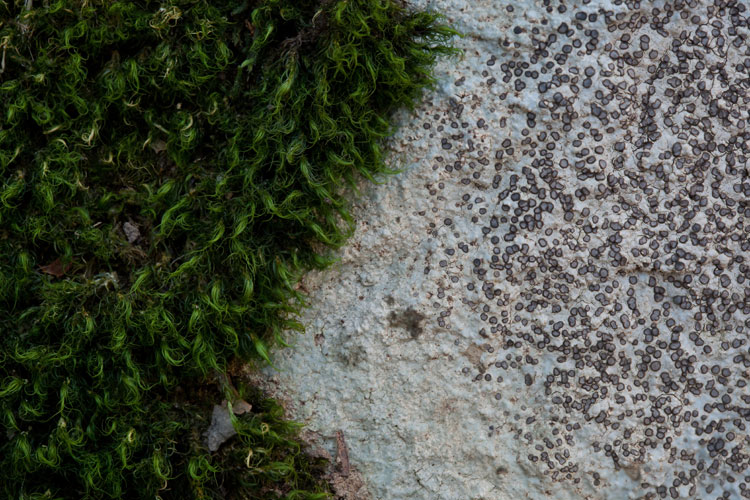
Ohio Moss and Lichen Association.
Ohio Moss and Lichen Association.
Crustose lichens are tightly adherent to the substrate, so much so that is impossible to collect them without removing a portion of the rock or bark they're growing upon. Amazingly, the hyphae (strands that make up a fungus's body) of crustose lichens such as Porpidia growing on coarse-grainbed granite can extend several millimeters deep into the rock! The smoky "eyes" of this lichen are its apothecia: disk-shaped aggregates of the microscopic spore-producing sacs (asci) characteristic of its fungal class (Ascomycota).
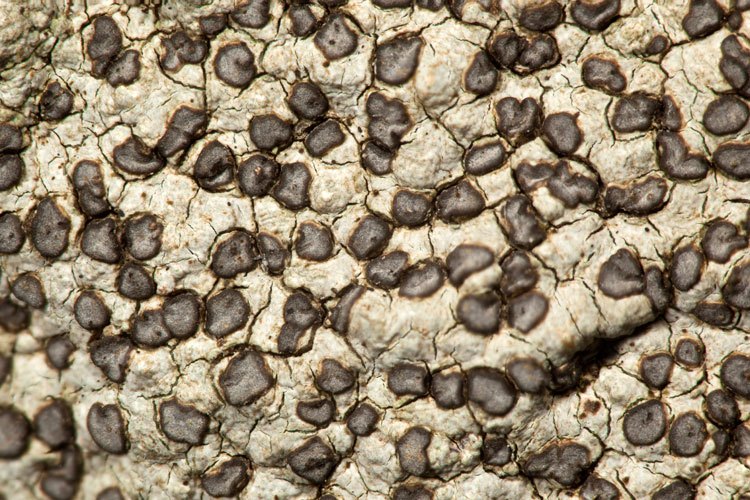
Porpidia albocaerulescens thallus is creamy gray, dotted with dark-gray, black-margined apothecia.
Porpidia albocaerulescens thallus is creamy gray, dotted with dark-gray, black-margined apothecia.
The moss is a fairly common cushion moss, a member of the "broom moss" genus Dicranum (Dicranaceae). These are especially narrow-leaved mosses that grow in dense velvety-stemmed tufts in a variety of habitats. This is Dicranum fulvum, a coarse plant found, according to Crum and Anderson in their magnificent and very overpriced tome, Mosses of Eastern North America (Columbia University Press), "On shaded acid rocks in deciduous woods, rarely on soil or bark at the base of trees."
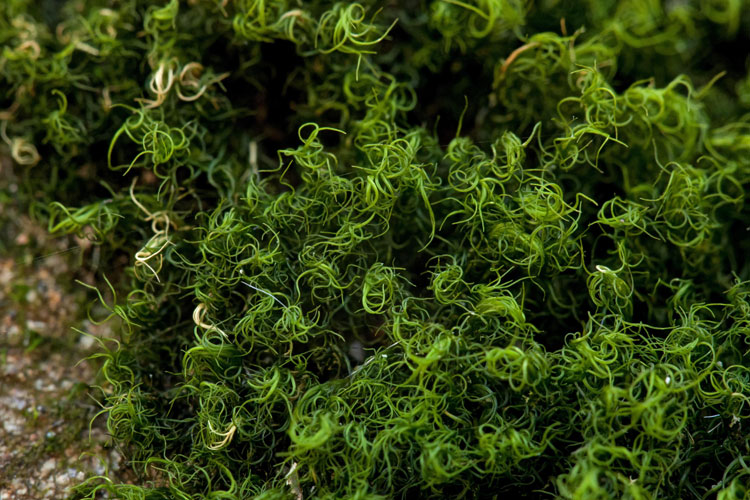
Dicranum fulvum leaves are very much crisped when dry.
October 17, 2010. Delaware County, Ohio.
Dicranum fulvum leaves are very much crisped when dry.
October 17, 2010. Delaware County, Ohio.
as Black-horned Tree Crickets Sing Summer Sign-off Song
OSU-Marion Prairie, October 8, 2010
Although some sources say the introduced European "praying mantis," Mantis religiosa, is the most common mantid in much of the U.S., the Chinese mantid, Tenodera aridifolia sinensis is especially abundant locally. Perhaps this is because this species is widely distributed through sales of its egg masses as a biological control agent, albeit one of questionable efficacy. This afternoon a female, with abdomen swollen full of eggs, is laying a clutch of them.
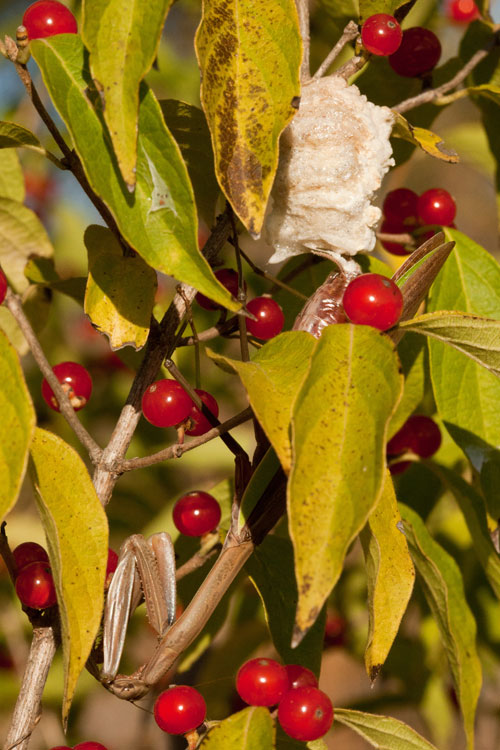
Chinese mantid laying a clucth of eggs at the OSU-Marion Prairie
October 8, 2010.
Explore Nature -There Are Surprises EverywhereChinese mantid laying a clucth of eggs at the OSU-Marion Prairie
October 8, 2010.
The eggs are covered with the characteristic protective layer that dries into a mass that resembles foam insulation.
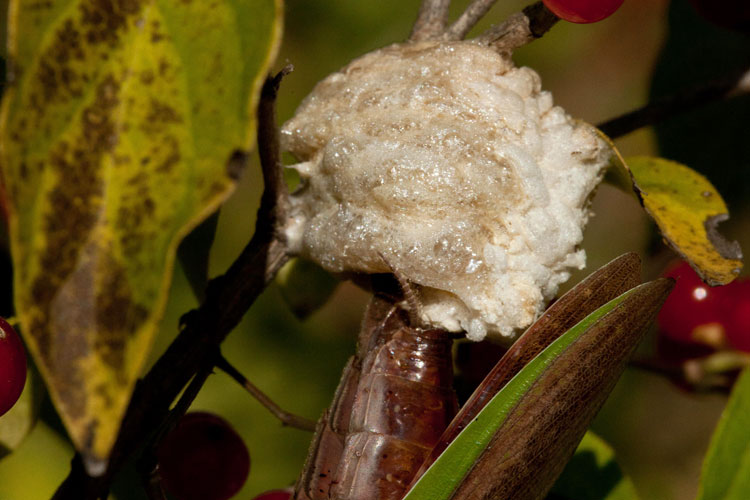
Tenodera aridfolia lathers eggs onto honeysuckle twig at the OSU-Marion Prairie.
Tenodera aridfolia lathers eggs onto honeysuckle twig at the OSU-Marion Prairie.
Mantids (Order Mantodea) are a primarily tropical group of insects. While there are about 2000 species worldwide, only 18 are native to North America, and just one, the Carolina mantid (Stagmomantis carolina) reaches into Ohio. Stephen Marshall, in the wonderful phographic guide "Insects - Their Natural History and Diversity" (Firefly Books) (p. 62) describes mantids in the following manner: "Much as termites are, in an evolutionary sense, social cockroaches, mantids are predaceous cockroaches. Give a roach large spiny grasping forelegs by enlarging its fore coxae, then stretch its prothorax out to keep the mobile head and spiny forelegs far forward of the vulnerable abdomen, and you have a well-designed predator called a mantid." Marshall also tells us that, owing to their "comically mobile" head, mantids are the only insects that can look over their shoulders.
Here's the head and shoulders of our egg-laying Tenodera.
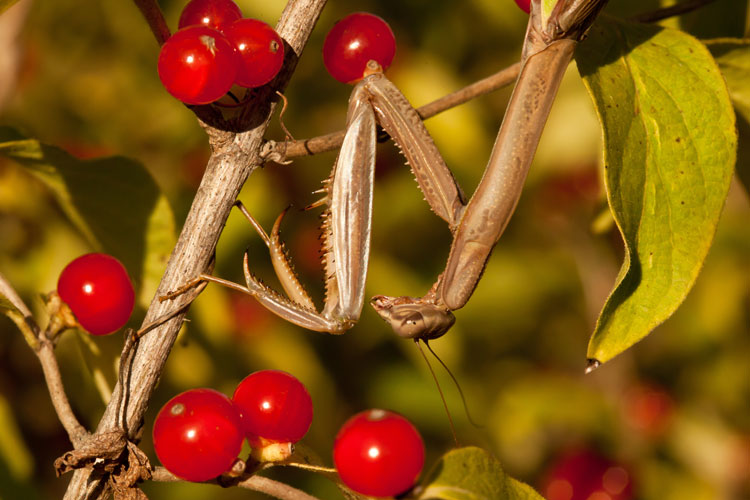
Mantids are "predacous roaches." October 8, 2010. Marion County, Ohio.
Here's the head and shoulders of our egg-laying Tenodera.
Mantids are "predacous roaches." October 8, 2010. Marion County, Ohio.
The OSU-Marion Prairie is home to a large and noisy population of black-horned tree crickets, Oecanthus nigricornis (Order Orthoptera, suborder Ensifera, the "long-horned orthopterans"). Their song is a loud continuous trill at a nice low pitch that I can actually hear --3.5 kiloHertz.
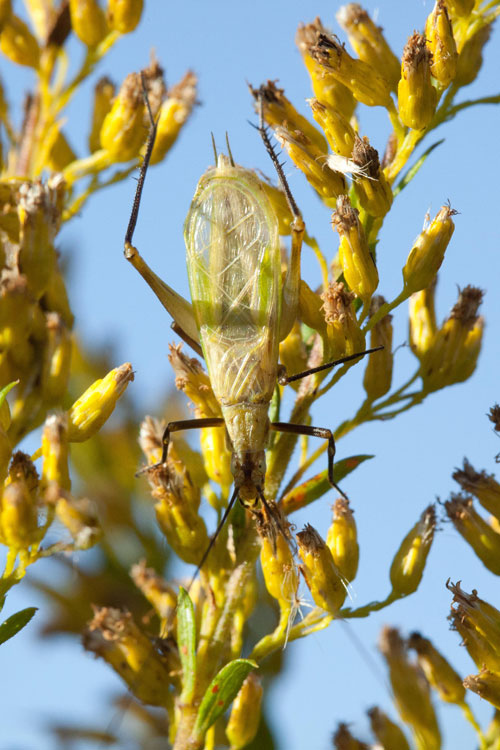
Black-horned tree cricket sings continuously in the daytime.
October 8, 2010. Marion County, Ohio.
Black-horned tree cricket sings continuously in the daytime.
October 8, 2010. Marion County, Ohio.
Unlike the approximately 1/2 dozen "lookalike" members of the genus which occur locally, and that are told apart by tiny markings at the bases of their antennae, black-horned tree crickets are instantly recognizable by the prominent black markings on the legs and antennae.
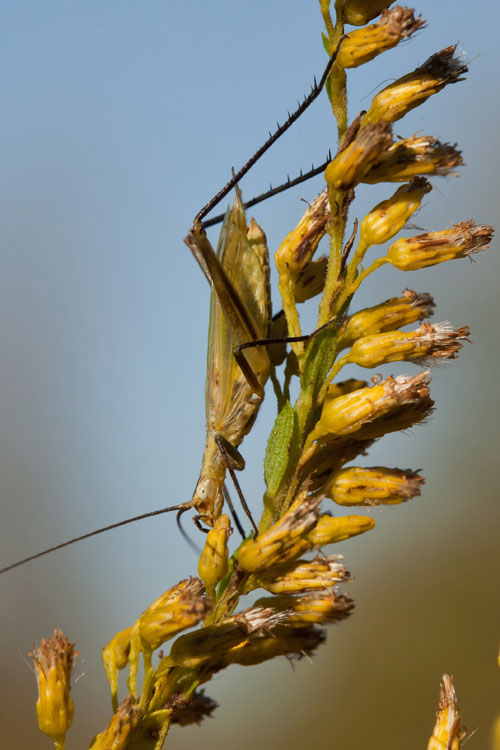
Black-horned tree crickets are instantly recognizable.
October 8, 2010. Marion County, Ohio.
Black-horned tree crickets are instantly recognizable.
October 8, 2010. Marion County, Ohio.
Meanwhile, at the edge of the Prairie pond, a recently captured and released dragonfly naiad peeks at all the commotion and decides it would be to better to stay underwater for a while longer.
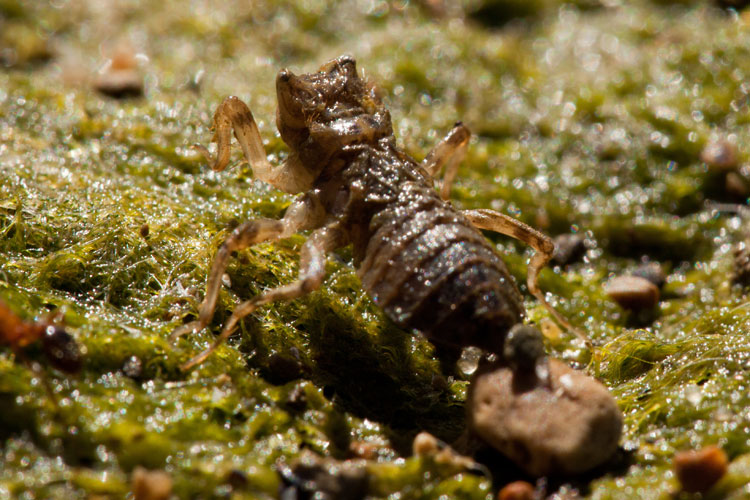
Dragonfly naiad at OSU-marion Prairie pond.
October 8, 2010.
Dragonfly naiad at OSU-marion Prairie pond.
October 8, 2010.
The Wilds and Vicinity
OMLA visits Muskingum County, October 2-3, 2010

This is a good sign.
Just outside of Zaneville, this quite nice sign beckons us to explore nature, and the best part of the sign is that it has a lot of BRYOPHYTES!
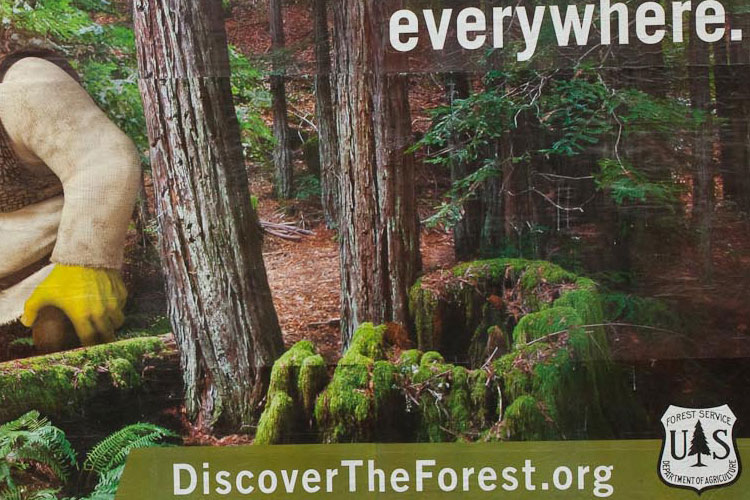
I'm guessing that's Tetraphis pellucida on the stump, and Hypnum imponens on the log.
(Shrek needs a hand lens!)
I'm guessing that's Tetraphis pellucida on the stump, and Hypnum imponens on the log.
(Shrek needs a hand lens!)
Every autumn the best little nature club in Ohio has its Fall Foray. This year the Ohio Moss and Lichen Association (OMLA) went to Muskingum County to see how many bryos and lichens we could scare up.
Here's us, about to do some scaring at The Wilds, a wonderful educational nature preserve that has gazelles and stuff, on abandoned and somewhat restored strip mined land in eastern Ohio. It's very cool.
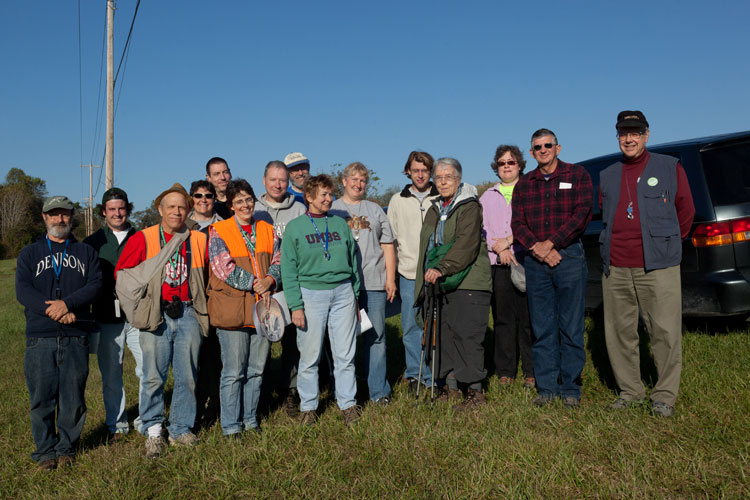
Fifteen friendly fall forayers. October 2, 2010.
The Wilds. Muskingum County, Ohio.
Here's us, about to do some scaring at The Wilds, a wonderful educational nature preserve that has gazelles and stuff, on abandoned and somewhat restored strip mined land in eastern Ohio. It's very cool.
Fifteen friendly fall forayers. October 2, 2010.
The Wilds. Muskingum County, Ohio.
Here's a fruticose lichen, common powderhorn, Cladonia coniocraea. Widespread in Ohio, this is our commonest Cladonia with pointed podetia, occuring on bark and various organic substrates such as tree bases in wooded areas. Notice that the upper portions of the podetia are mealy sorediate (beset with powdery particles of fungal hyphae and algal cells called soredia that can slough off and form new individuals) at the their tops, but are smooth (having a distinct outer layer, the cortex) on their lower portions.
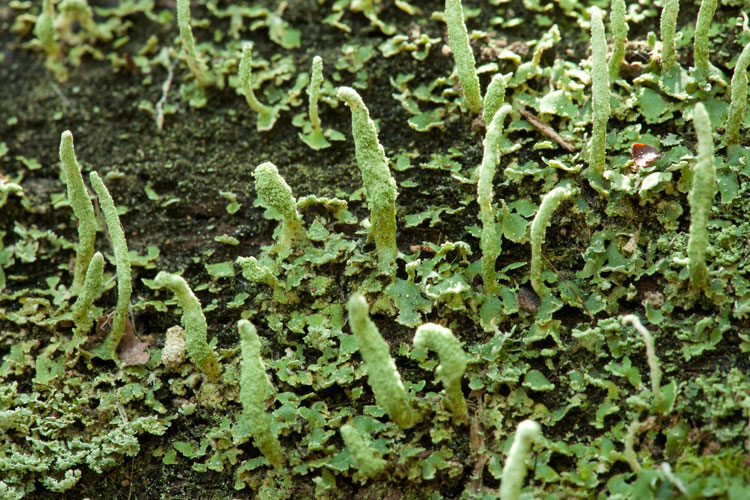
Common powderhorn has pointed podetia. October 2, 2011. Muskinghum County.
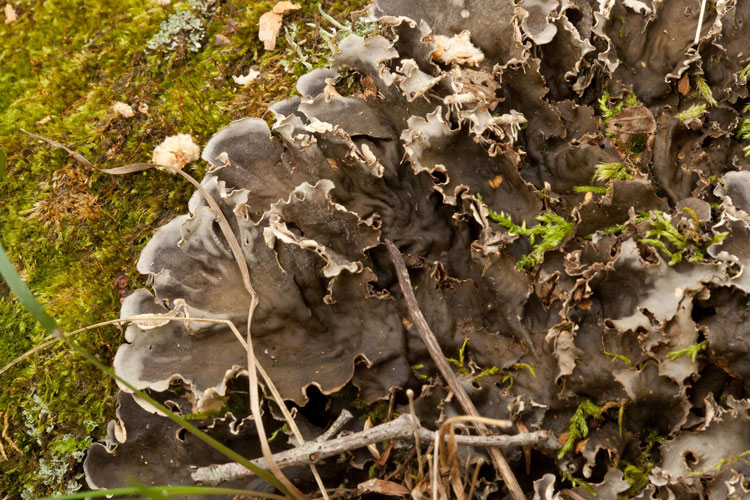
Lichen, dog, on a log, in Muskingum County. October 2, 2010.
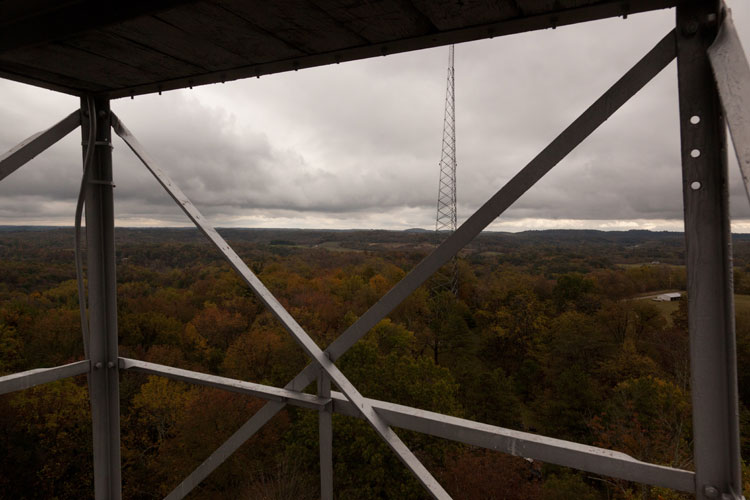
OOOH! View from fire tower at Blue Rocks State Park. Vista, vista!
October 3, 2010. Muskingum County, Ohio.
Common powderhorn has pointed podetia. October 2, 2011. Muskinghum County.
Pelt, or dog lichens, genus Peltigera, are especially large, loosely attached, gray to brown foliose lichens with an unusual feature --the photosynthesizing member of the partnership (called the "phycobiont") consists not of green algae as is usually the case, but rather cyanobacteria! Two species of pelt (P. canina and P. evansiana) were recorded on the Foray. This one, with an upper surface that is not cracked at the periphery, appears to be dog lichen, Peltigera canina.
Lichen, dog, on a log, in Muskingum County. October 2, 2010.
Apparently this region was not only a site for coal excavation, but also oil or perhaps natural gas extraction? This ancient piece of machinery seems to have had something to do with pumping. There are surprises everywhere!
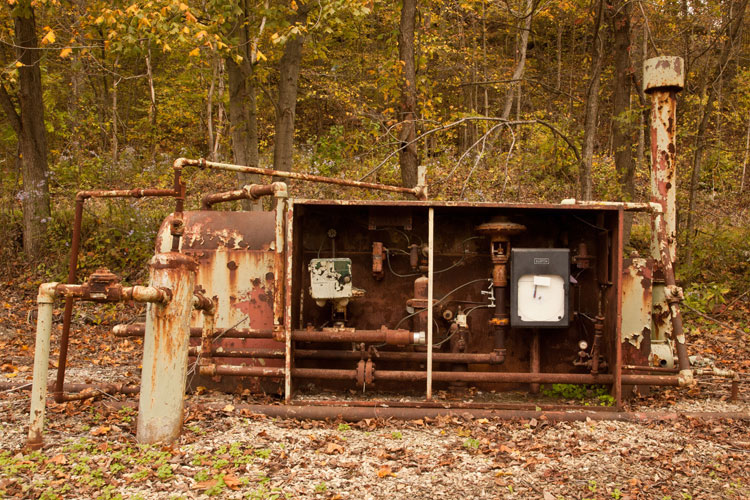
Machinery in the woods. Muskingum County, Ohio. October 2, 2010.
Day two was spent exploring Blue Rocks State Park. A common bryophyte here, and everywhere else in Ohio, is a robust carpet moss that grows on soil in open wooded areas. Bryoandersonia illecebra (Brachytheciaceae) form dense soft yellow-green tufts.
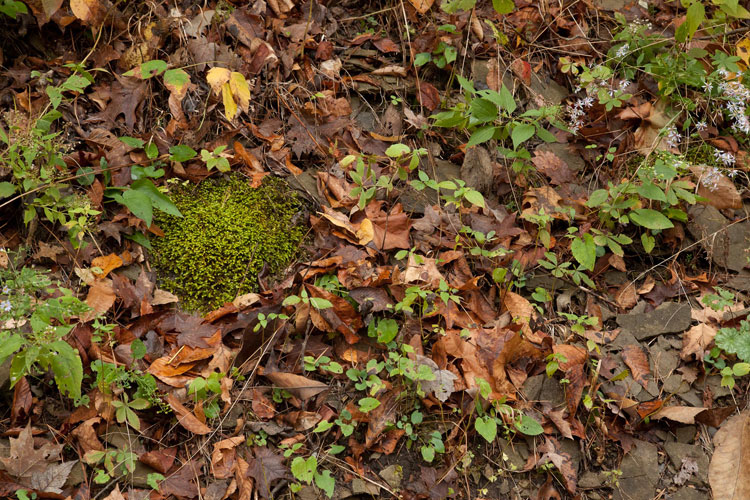
Bryoandersonia illecebra is a robust carpet moss that grows in soil.
October 3, 2010. Blue Rocks State Park. Muskingum County, Ohio.
The area around the BRSP fire tower was the funnest. Actually, climbing the fire tower was the funnest. I love fire towers. Here's the view from up there. Oooooh. As my mother used to say..."Vista! Vista!"
Machinery in the woods. Muskingum County, Ohio. October 2, 2010.
Day two was spent exploring Blue Rocks State Park. A common bryophyte here, and everywhere else in Ohio, is a robust carpet moss that grows on soil in open wooded areas. Bryoandersonia illecebra (Brachytheciaceae) form dense soft yellow-green tufts.
Bryoandersonia illecebra is a robust carpet moss that grows in soil.
October 3, 2010. Blue Rocks State Park. Muskingum County, Ohio.
Up close, Bryoandersonia is distinctive by virtue of its deeply concave leaves that completely surround the stems and branches in a puffy manner (the technical term is "julaceous") giving them a worm-like appearance. Indeed, one common name for this species is "white worm moss."
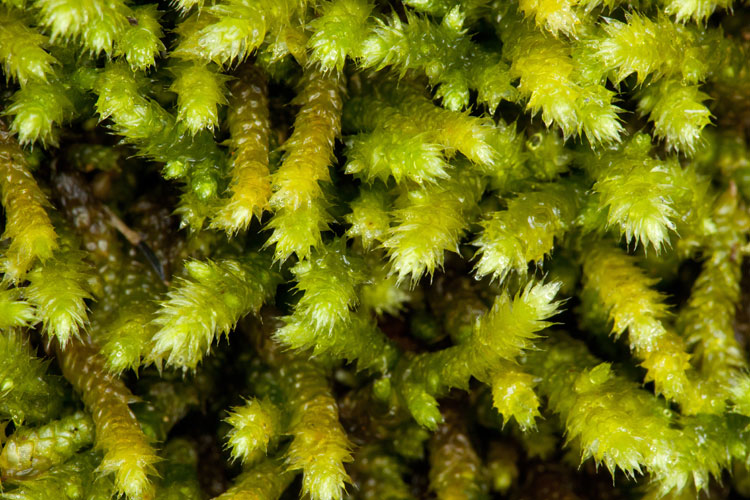
Bryoandersonia illecebra is "white worm moss."
October 3, 2010. Muskingum County, Ohio.
Bryoandersonia illecebra is "white worm moss."
October 3, 2010. Muskingum County, Ohio.
OOOH! View from fire tower at Blue Rocks State Park. Vista, vista!
October 3, 2010. Muskingum County, Ohio.
This isn't the first time I've been up this tower. In early June, 1999, the spectacular Brood V of Linneaus's 17-year cicada was in full force, and this tower was a great place from which to view the commotion. I had a camcorder. VHS tape. How quaint.
FLASHBACK! 1999 Brood V of the 17-year cicadas.
(But where is that tall thin metal tower?)
FLASHBACK! 1999 Brood V of the 17-year cicadas.
(But where is that tall thin metal tower?)
Here's the scary view looking down from the fire tower. It's very impressive that the State Park people set up nature interpretative signage pointing out mushrooms on the lawn that can be seen from the air.
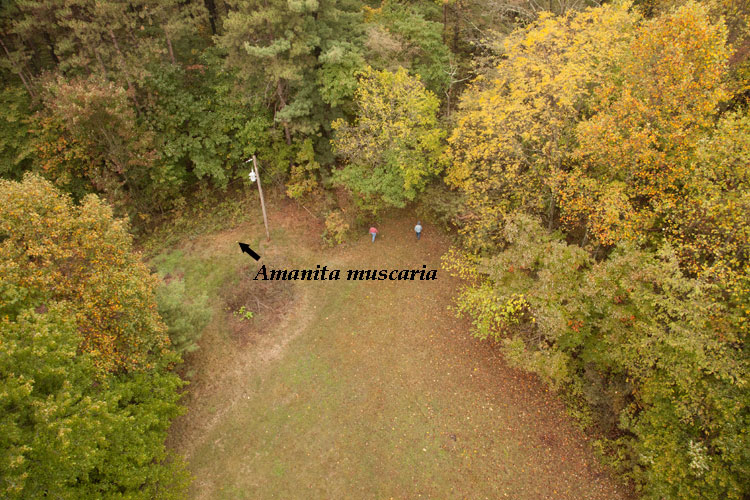
Fly's-eye view of fly agaric mushrooms.
Fly's-eye view of fly agaric mushrooms.
Here's a ground-level view of that pair of fly agarics. Amanita muscaria is a large colorful gilled mushroom that is common across much of northern and temperate regions of the Northern hemisphere. The warts atop the cap are remnants of the universal veil, a covering that surrounded the mushroom early in its development, and that is a principal trait for recognizing the genus.
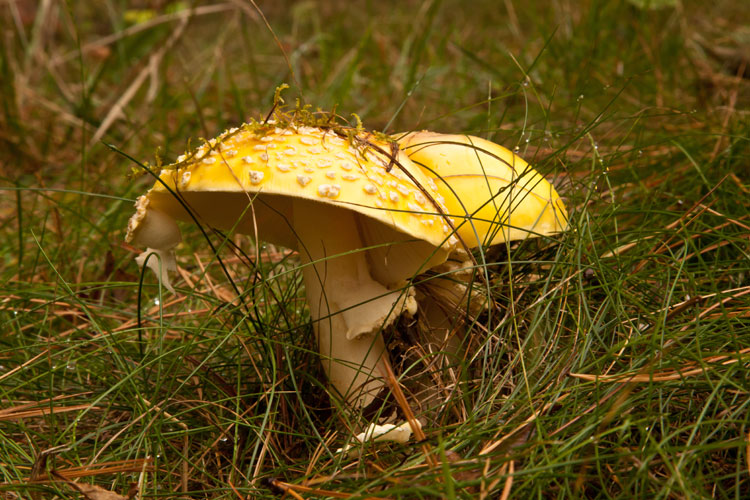
Amanita muscaria is a large colorful mushroom.
Blue Rocks State Park. Muskingum County, Ohio. October 3, 2010.
Amanita muscaria is a large colorful mushroom.
Blue Rocks State Park. Muskingum County, Ohio. October 3, 2010.
Here's another mushroom, also distinctive, but a wee bit too small to be seen from the tower, even if it does get a boost by growing high on a tree. It's "bark mycena," Mycena corticola. Cute.
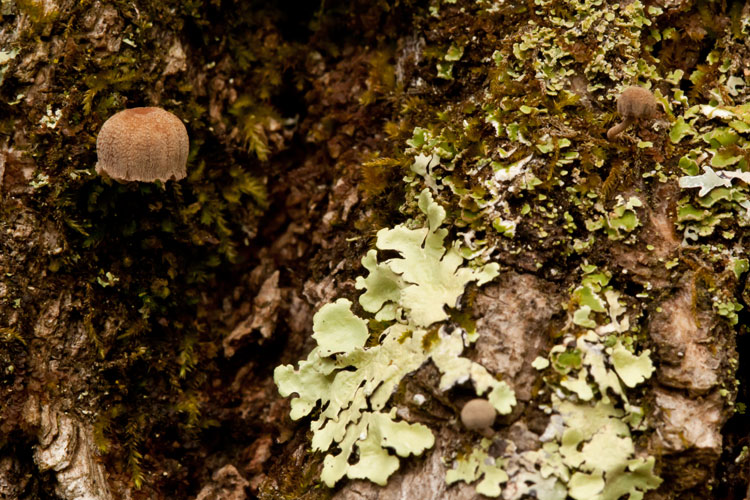
Mycena corticola is a tiny mushroom that grows on bark.
Mycena corticola is a tiny mushroom that grows on bark.
This old picnic table is a nice lichen substrate. On the vertical surfaces it's got oodles of the same common yellowish-green foliose lichen, Flavoparmelia caperata, that's keeping bark mycena company.

Picnic table is lichen substrate. Blue Rocks State Park. October 3, 2010.
Picnic table is lichen substrate. Blue Rocks State Park. October 3, 2010.
A close look at the dorsal surface of Table picnic (Lawnfurnituraceae) reveals a neat little frutcose lichen. This is "lipstick powderhorn," Cladonia macilenta. Lipstick powderhorn has pointed podetia as does yesterday's common powderhorn, but it differs in that these are tipped with tiny bright red apothecia.
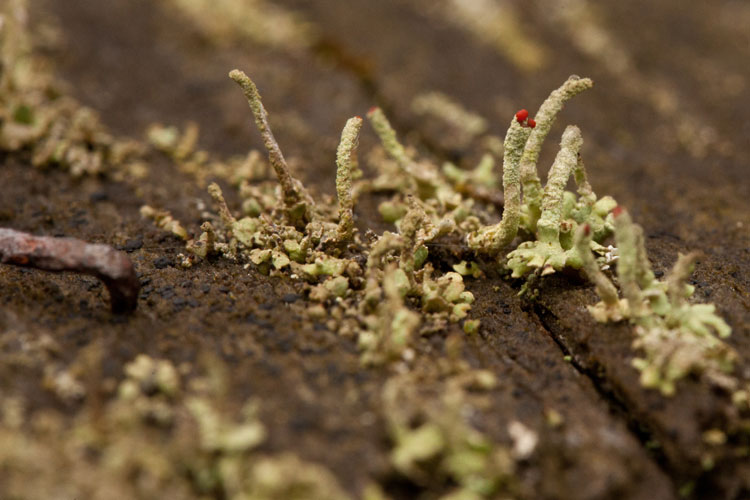
Lipstick powderhorn lichen, Cladonia macilenta. Blue Rocks State Park. October 3, 2010.
Yum. In a field nearby there's a big Chinese chestnut, Castanea mollissima (Fagaceae), in full fruit. The ground is littered with them. I scooped up a bunch and roasted them in a closed oven. Scrumptious!
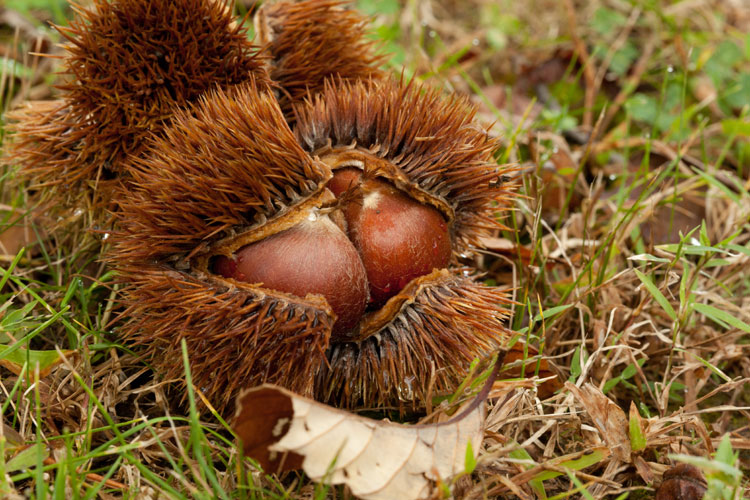
Chinese chestnut fruits, ripe and delicious.
Surprises are everywhere!


Chinese chestnut fruits, ripe and delicious.
Surprises are everywhere!